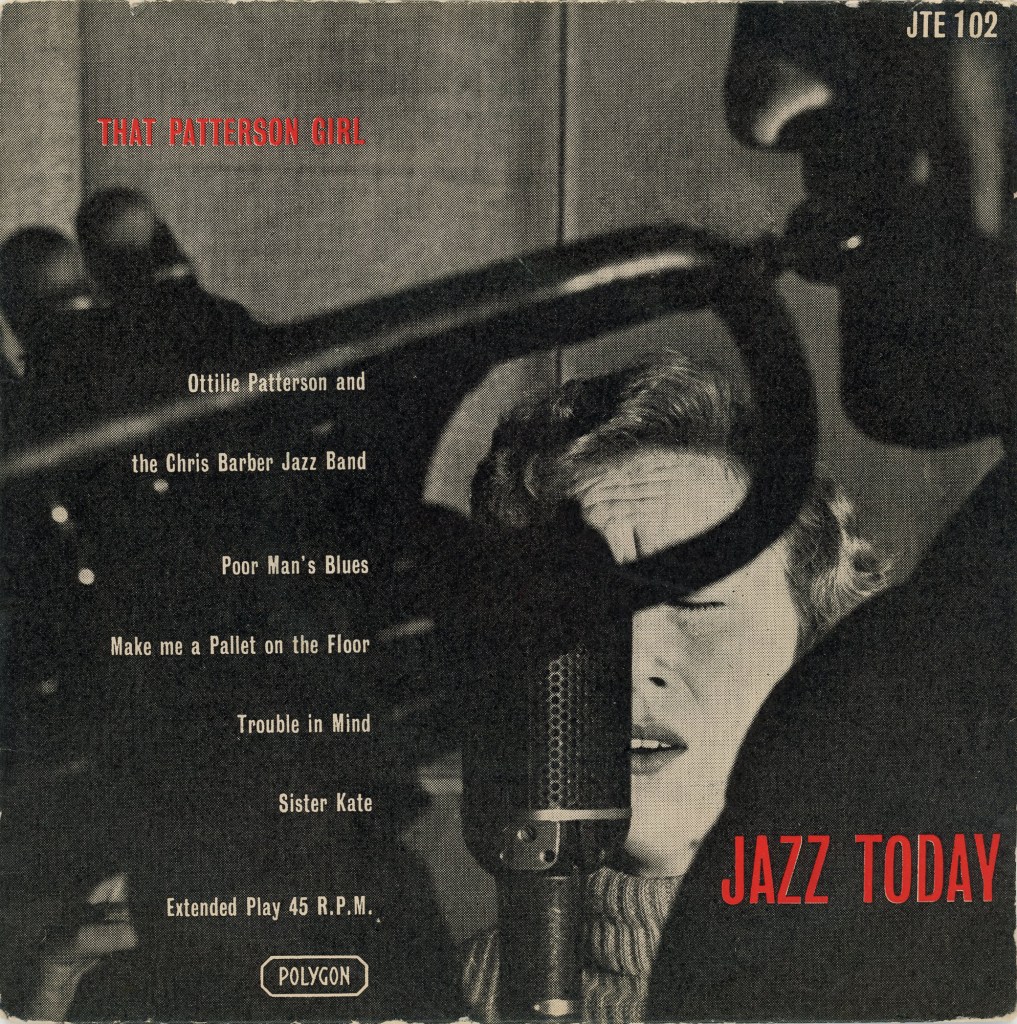
Polygon JTE 102
Jazz Today
7” EP
Recorded March 1955
TRACKS
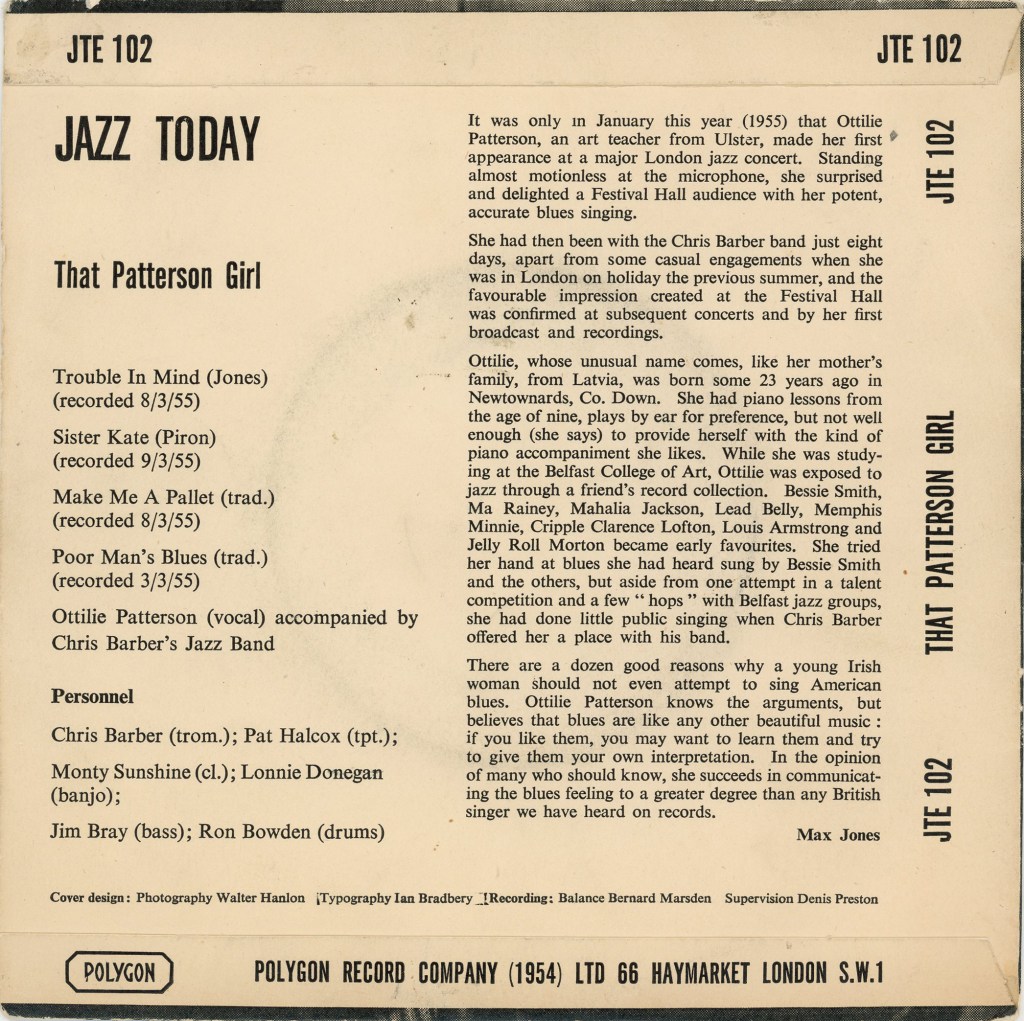
Trouble In Mind (Jones)
(recorded 8/3/55)
Sister Kate (Piron)
(recorded 9/3/55)
Make Me A Pallet (trad.)
(recorded 8/3/55)
Poor Man’s Blues (trad.)
(recorded 3/3/55)
SLEEVE NOTES
It was only in January this year (1955) that Ottilie Patterson, an art teacher from Ulster, made her first appearance at a major London jazz concert. Standing almost motionless at the microphone, she surprised and delighted a Festival Hall audience with her potent, accurate blues singing.
She had then been with the Chris Barber band just eight days, apart from some casual engagements when she was in London on holiday the previous summer, and the favourable impression created at the Festival Hall was confirmed at subsequent concerts and by her first broadcast and recordings.
Ottilie, whose unusual name comes, like her mother’s family, from Latvia, was born some 23 years ago in Newtownards, Co. Down. She had piano lessons from the age of nine, plays by ear for preference, but not well enough (she says) to provide herself with the kind of piano accompaniment she likes. While she was study ing at the Belfast College of Art, Ottilie was exposed to jazz through a friend’s record collection. Bessie Smith, Ma Rainey, Mahalia Jackson, Lead Belly, Memphis Minnie, Cripple Clarence Lofton, Louis Armstrong and Jelly Roll Morton became early favourites. She tried her hand at blues she had heard sung by Bessie Smith and the others, but aside from one attempt in a talent competition and a few “hops ” with Belfast jazz groups, she had done little public singing when Chris Barber offered her a place with his band.
There are a dozen good reasons why a young Irish woman should not even attempt to sing American blues. Ottilie Patterson knows the arguments, but believes that blues are like any other beautiful music : if you like them, you may want to learn them and try to give them your own interpretation. In the opinion of many who should know, she succeeds in communicat ing the blues feeling to a greater degree than any British singer we have heard on records.
Max Jones
PERSONNEL
Chris Barber (trom.); Pat Halcox (tpt.);
Monty Sunshine (cl.); Lonnie Donegan (banjo);
Jim Bray (bass); Ron Bowden (drums)
Sleeve:
Ian Bradbery (design)
Walter Hanlon (photography)
Recording:
Bernard Marsden (balance)
Denis Preston (supervision)
MEDIA/MENTIONS
Record Highlights of 1955 by Peter Stanswood
Jazz Music Magazine Vol.7 No.1 1956
OTTILIE PATTERSON POLY. JT102. Oh that Bessie Smith could have recorded with the same equipment as Miss Patterson did on this EP, not that she would have “carved” Miss Patterson up, for I predict that one day this young girl from the Emerald Isle will rank alongside Betty and Ma Rainey. This EP will corroborate my statement, well backed up by the Chris Barber Group Ottilie sings four standards of which “Trouble in mind” and “Sister Kate” are the most outstanding. Congratulations also go to Bernard Marsden the man behind the fine quality of this recording.
Tiger
The Big Voice Of Little Miss Blues
Douglas Enfer’s Fanfare
Aberdeen Evening Express – 16 July 1955
Miss Ottilie Patterson is a small, shy girl with a small, shy speaking voice who stands in front of a microphone with her hands locked behind her back.
But when she opens her mouth what comes out is just about the most massive singing voice heard since the fabulous days of Bessie Smith and Ma Rainey.
Miss Patterson is a 23-year-old from Ulster, who came over to Britain to be an art teacher. Instead, she became a blues singer with the Chris Barber Jazz Band.
When I met her she was wearing a pale blue frock under a pale blue cardigan. A sort of Little Miss Blues.
I asked: “Where does the Big Voice come from?”
Miss Patterson spread her hands with a nervous gesture. I don’t know, I guess. I just open my mouth and it just comes out that way.”
Well it does that all right. Like a bomb.
Now it is true that little Mss Patterson is frankly a copyist. She is creating nothing new in jazz. But what a remarkable copyist she is, to be sure.
Besides, how much of all current jazz – vocal and instrumental, ancient and modern – is copyist?
Consider the trumpeters who play (ir wish they did) like Armstrong or Gillespie. The saxophonists who wished they played like Bechet or Mulligan: the pianists who hope you will mistake them for Hines or Brubeck.
Yet, it is still true hat there is no girl blues singer on hand whose voice so astonishingly reminds you of Bessie Smith.
And that, my friends, is something….
Even if Miss Patterson should get a little discouraged and go back to teaching art, she can be sure of one thing – the blues she sings will last long, long after the biggest-selling pop of 1955 has made its softly, softly exit into the endless night of oblivion.
DISCSTARS
*** To That Patterson Girl, in which Miss Ottilie Patterson – discussed in accompanying article – goes through three all-times blues with the splendid aid of the Barber band. She is least successful in an up-tempo version of Sister Kate. Extended-play Polygon JTE 102.
*** To Jazz To-day, this time Chris Barber’s group presenting the immortal music of Clarence and Spencer Williams. Some first-rate playing by one of Britain’s best traditional bands – and the disc also has that Patterson girl singing a fine and mellow version of Careless Love. Long-playing Polygon JTL 3.
 Nixa Jazz Today