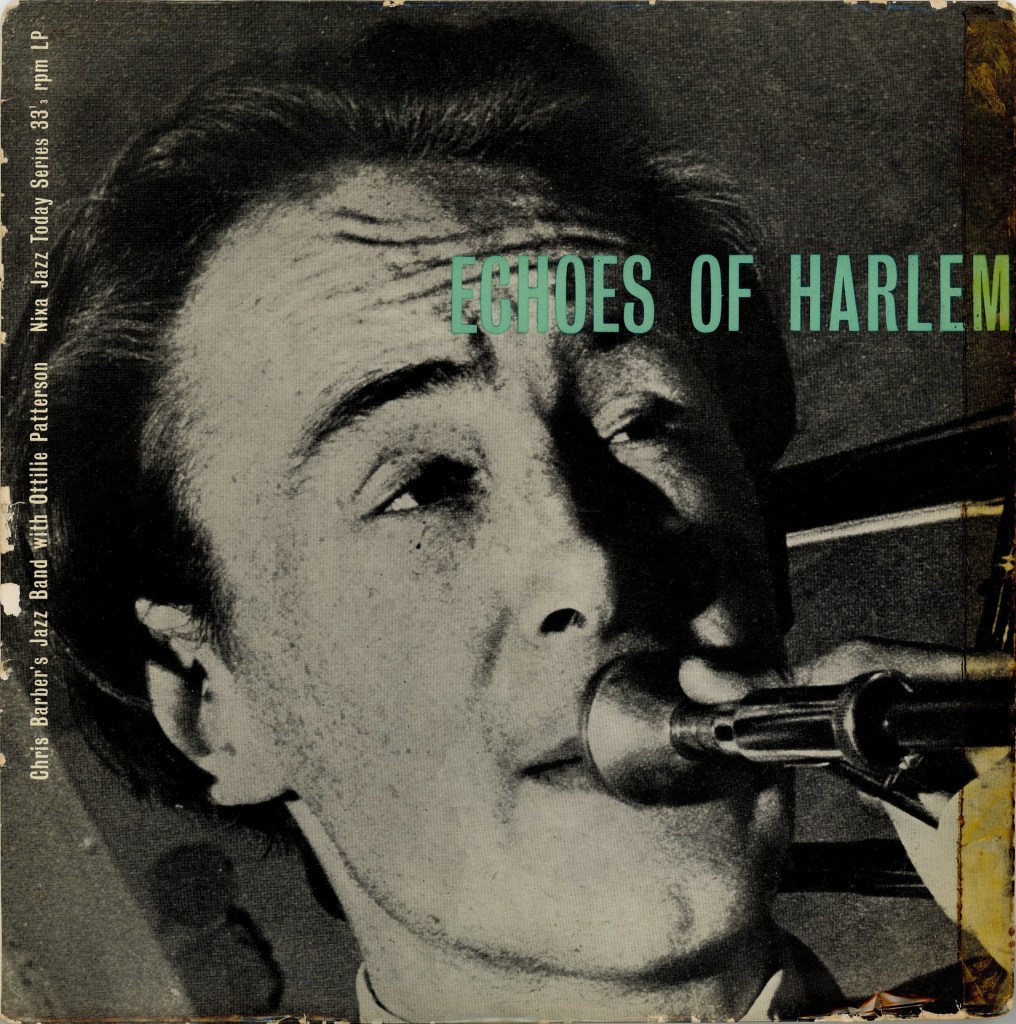
Pye Nixa NJL 1
Nixa Jazz Today Series
12” LP
Recorded Sept 1955
Tracks
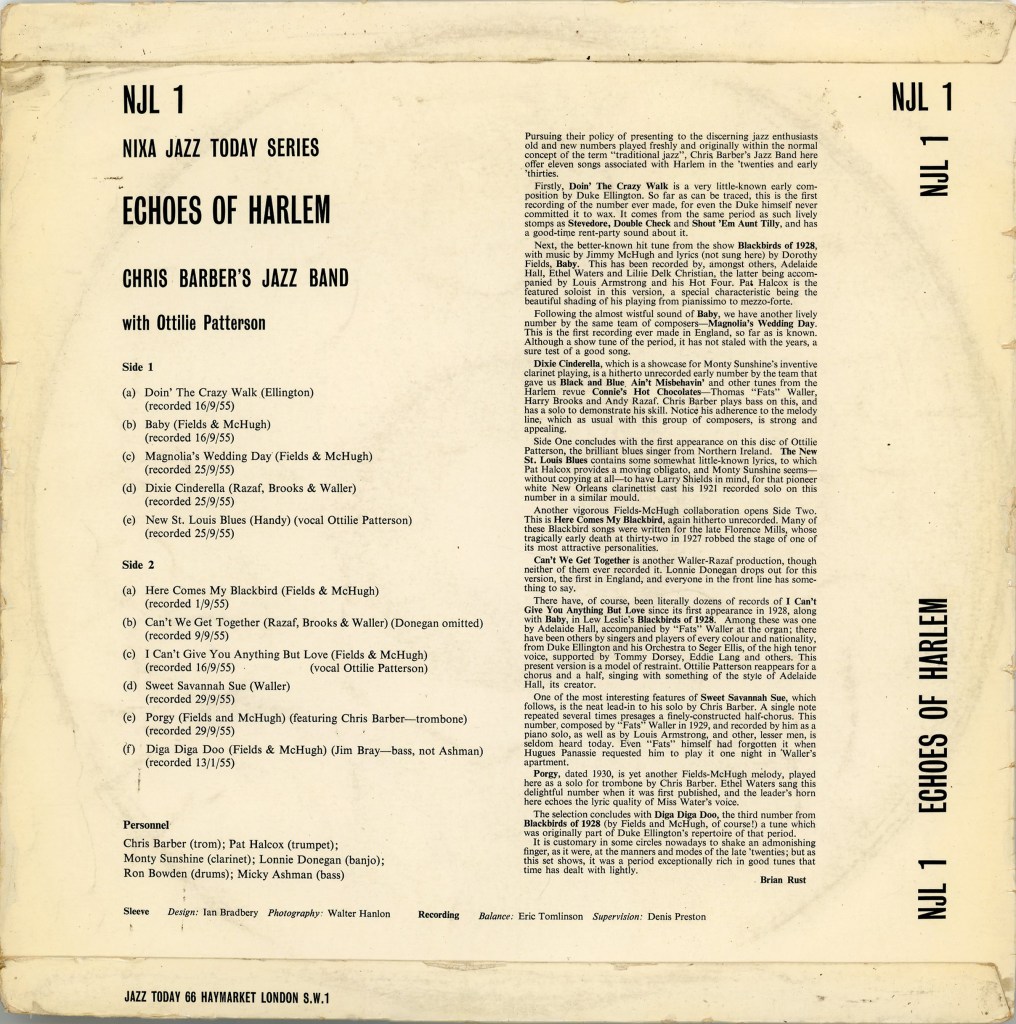
Side 1
(a) Doin’ The Crazy Walk (Ellington)
(recorded 16/9/55)
(b) Baby (Fields & McHugh)
(recorded 16/9/55)
(c) Magnolia’s Wedding Day (Fields & McHugh)
(recorded 25/9/55)
(d) Dixie Cinderella (Razaf, Brooks & Waller)
(recorded 25/9/55)
(e) New St. Louis Blues (Handy) (vocal Ottilie Patterson)
(recorded 25/9/55)
Side 2
(a) Here Comes My Blackbird (Fields & McHugh)
(recorded 1/9/55)
(b) Can’t We Get Together (Razaf, Brooks & Waller) (Donegan omitted)
(recorded 9/9/55)
(c) I Can’t Give You Anything But Love (Fields & McHugh)
(recorded 16/9/55) (vocal Ottilie Patterson)
(d) Sweet Savannah Sue (Waller)
(recorded 29/9/55)
(e) Porgy (Fields and McHugh) (featuring Chris Barber-trombone)
(recorded 29/9/55)
(f) Diga Diga Doo (Fields & McHugh) (Jim Bray-bass, not Ashman)
(recorded 13/1/55)
Sleeve Notes
Pursuing their policy of presenting to the discerning jazz enthusiasts old and new numbers played freshly and originally within the normal concept of the term “traditional jazz”, Chris Barber’s Jazz Band here offer eleven songs associated with Harlem in the ‘twenties and early thirties.
Firstly, Doin’ The Crazy Walk is a very little-known early composition by Duke Ellington. So far as can be traced, this is the first recording of the number ever made, for even the Duke himself never committed it to wax. It comes from the same period as such lively stomps as Stevedore, Double Check and Shout ‘Em Aunt Tilly, and has a good-time rent-party sound about it.
Next, the better-known hit tune from the show Blackbirds of 1928, with music by Jimmy McHugh and lyrics (not sung here) by Dorothy Fields, Baby. This has been recorded by, amongst others, Adelaide Hall, Ethel Waters and Lillie Delk Christian, the latter being accompanied by Louis Armstrong and his Hot Four. Pat Halcox is the featured soloist in this version, a special characteristic being the beautiful shading of his playing from pianissimo to mezzo-forte.
Following the almost wistful sound of Baby, we have another lively number by the same team of composers – Magnolia’s Wedding Day. This is the first recording ever made in England, so far as is known. Although a show tune of the period, it has not staled with the years, a sure test of a good song.
Dixie Cinderella, which is a showcase for Monty Sunshine’s inventive clarinet playing, is a hitherto unrecorded early number by the team that gave us Black and Blue, Ain’t Misbehavin’ and other tunes from the Harlem revue Connie’s Hot Chocolates – Thomas “Fats” Waller, Harry Brooks and Andy Razaf. Chris Barber plays bass on this, and has a solo to demonstrate his skill. Notice his adherence to the melody line, which as usual with this group of composers, is strong and appealing.
Side One concludes with the first appearance on this disc of Ottilie Patterson, the brilliant blues singer from Northern Ireland. The New St. Louis Blues contains some somewhat little-known lyrics, to which Pat Halcox provides a moving obligato, and Monty Sunshine seems – without copying at all – to have Larry Shields in mind, for that pioneer white New Orleans clarinettist cast his 1921 recorded solo on this number in a similar mould.
Another vigorous Fields-McHugh collaboration opens Side Two. This is Here Comes My Blackbird, again hitherto unrecorded. Many of these Blackbird songs were written for the late Florence Mills, whose tragically early death at thirty-two in 1927 robbed the stage of one of its most attractive personalities.
Can’t We Get Together is another Waller-Razaf production, though neither of them ever recorded it. Lonnie Donegan drops out for this version, the first in England, and everyone in the front line has some thing to say.
There have, of course, been literally dozens of records of I Can’t Give You Anything But Love since its first appearance in 1928, along with Baby, in Lew Leslie’s Blackbirds of 1928. Among these was one by Adelaide Hall, accompanied by “Fats” Waller at the organ; there have been others by singers and players of every colour and nationality, from Duke Ellington and his Orchestra to Seger Ellis, of the high tenor voice, supported by Tommy Dorsey, Eddie Lang and others. This present version is a model of restraint. Ottilie Patterson reappears for a chorus and a half, singing with something of the style of Adelaide Hall, its creator.
One of the most interesting features of Sweet Savannah Sue, which follows, is the neat lead-in to his solo by Chris Barber. A single note repeated several times presages a finely-constructed half-chorus. This number, composed by “Fats” Waller in 1929, and recorded by him as a piano solo, as well as by Louis Armstrong, and other, lesser men, is seldom heard today. Even “Fats” himself had forgotten it when Hugues Panassie requested him to play it one night in Waller’s apartment.
Porgy, dated 1930, is yet another Fields-McHugh melody, played here as a solo for trombone by Chris Barber. Ethel Waters sang this delightful number when it was first published, and the leader’s horn here echoes the lyric quality of Miss Water’s voice.
The selection concludes with Diga Diga Doo, the third number from Blackbirds of 1928 (by Fields and McHugh, of course!) a tune which was originally part of Duke Ellington’s repertoire of that period. It is customary in some circles nowadays to shake an admonishing finger, as it were, at the manners and modes of the late twenties; but as this set shows, it was a period exceptionally rich in good tunes that time has dealt with lightly.
Brian Rust
Personnel
Chris Barber (trom); Pat Halcox (trumpet);
Monty Sunshine (clarinet); Lonnie Donegan (banjo);
Ron Bowden (drums); Micky Ashman (bass)
Sleeve:
Design: Ian Bradbery
Photography: Walter Hanlon
Recording:
Balance: Eric Tomlinson
Supervision: Denis Preston
 Nixa Jazz Today