Pye Nixa NJL 3
Nixa Jazz Today Series
12” LP
Recorded Jan-Mar 1956
Tracks
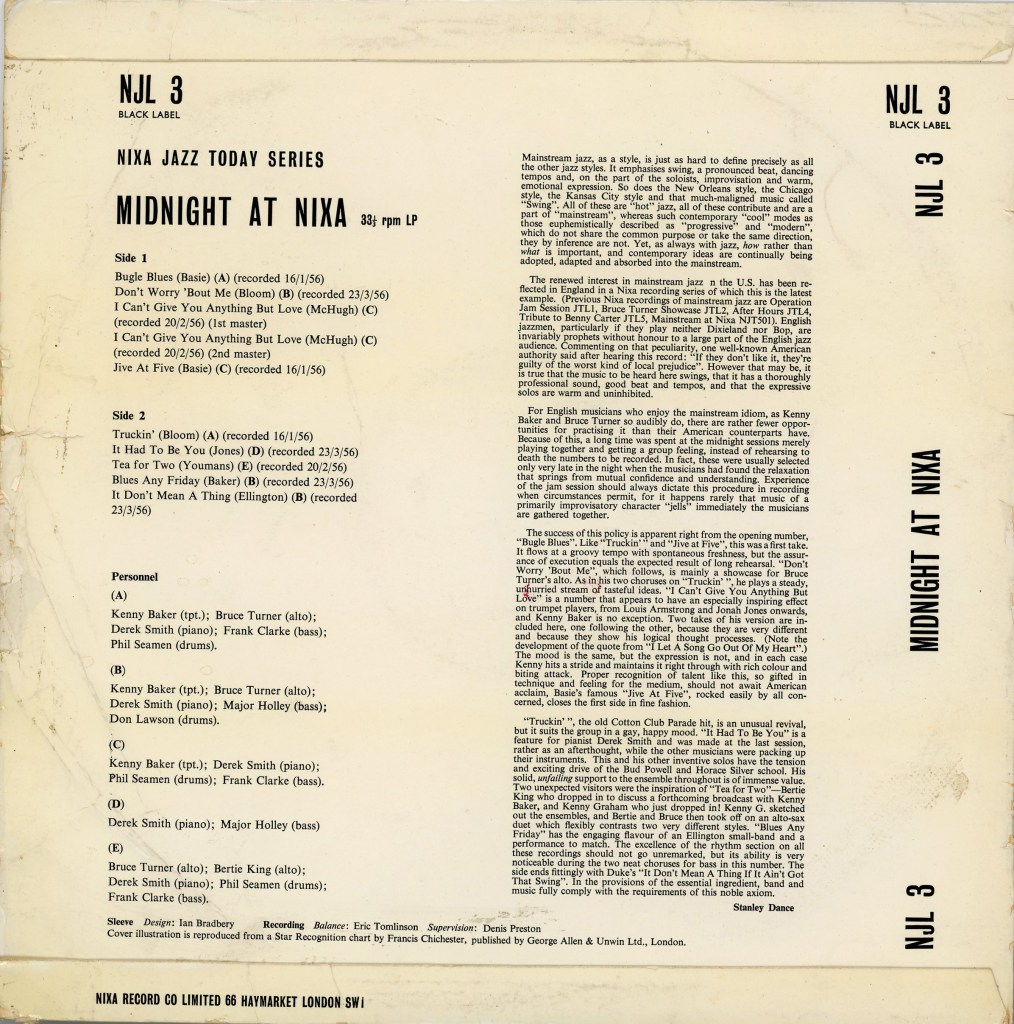
Side 1
Bugle Blues (Basic) (A) (recorded 16/1/56)
Don’t Worry ‘Bout Me (Bloom) (B) (recorded 23/3/56)
I Can’t Give You Anything But Love (McHugh) (C) (recorded 20/2/56) (1st master)
I Can’t Give You Anything But Love (McHugh) (C) (recorded 20/2/56) (2nd master)
Jive At Five (Basie) (C) (recorded 16/1/56)
Side 2
Truckin’ (Bloom) (A) (recorded 16/1/56)
It Had To Be You (Jones) (D) (recorded 23/3/56)
Tea for Two (Youmans) (E) (recorded 20/2/56)
Blues Any Friday (Baker) (B) (recorded 23/3/56)
It Don’t Mean A Thing (Ellington) (B) (recorded 23/3/56)
Sleeve Notes
Mainstream jazz, as a style, is just as hard to define precisely as all the other jazz styles. It emphasises swing, a pronounced beat, dancing tempos and, on the part of the soloists, improvisation and warm, emotional expression. So does the New Orleans style, the Chicago style, the Kansas City style and that much-maligned music called “Swing”. All of these are “hot” jazz, all of these contribute and are a part of “mainstream”, whereas such contemporary “cool” modes as those euphemistically described as “progressive” and “modern”, which do not share the common purpose or take the same direction, they by inference are not. Yet, as always with jazz, how rather than what is important, and contemporary ideas are continually being adopted, adapted and absorbed into the mainstream.
The renewed interest in mainstream Jazz n the U.S. has been re flected in England in a Nixa recording series of which this is the latest example. (Previous Nixa recordings of mainstream jazz are Operation Jam Session JTLI, Bruce Turner Showcase JTL2, After Hours JTL4, Tribute to Benny Carter JTL5, Mainstream at Nixa NJT501). English jazzmen, particularly if they play neither Dixieland nor Bop, are invariably prophets without honour to a large part of the English jazz audience. Commenting on that peculiarity, one well-known American authority said after hearing this record: “If they don’t like it, they’re guilty of the worst kind of local prejudice”. However that may be, it is true that the music to be heard here swings, that it has a thoroughly professional sound, good beat and tempos, and that the expressive solos are warm and uninhibited.
For English musicians who enjoy the mainstream idiom, as Kenny Baker and Bruce Turner so audibly do, there are rather fewer opportunities for practising it than their American counterparts have. Because of this, a long time was spent at the midnight sessions merely playing together and getting a group feeling, instead of rehearsing to death the numbers to be recorded. In fact, these were usually selected only very late in the night when the musicians had found the relaxation that springs from mutual confidence and understanding. Experience of the jam session should always dictate this procedure in recording when circumstances permit, for it happens rarely that music of a primarily improvisatory character “jells” immediately the musicians are gathered together.
The success of this policy is apparent right from the opening number, “Bugle Blues”. Like “Truckin” and “Jive at Five”, this was a first take. It flows at a groovy tempo with spontaneous freshness, but the assurance of execution equals the expected result of long rehearsal. “Don’t Worry ‘Bout Me”, which follows, is mainly a showcase for Bruce Turner’s alto. As in his two choruses on “Truckin'” he plays a steady, unhurried stream of tasteful ideas. “I Can’t Give You Anything But Love” is a number that appears to have an especially inspiring effect on trumpet players, from Louis Armstrong and Jonah Jones onwards, and Kenny Baker is no exception. Two takes of his version are included here, one following the other, because they are very different. and because they show his logical thought processes. (Note the development of the quote from “I Let A Song Go Out Of My Heart”) The mood is the same, but the expression is not, and in each case Kenny hits a stride and maintains it right through with rich colour and biting attack. Proper recognition of talent like this, so gifted in technique and feeling for the medium, should not await American acclaim. Basie’s famous “Jive At Five”, rocked easily by all concerned, closes the first side in fine fashion.
“Truckin'”, the old Cotton Club Parade hit, is an unusual revival, but it suits the group in a gay, happy mood. “It Had To Be You” is a feature for pianist Derek Smith and was made at the last session, rather as an afterthought, while the other musicians were racking up their instruments. This and his other inventive solos have the tension and exciting drive of the Bud Powell and Horace Silver school. His solid, unfailing support to the ensemble throughout is of immense value. Two unexpected visitors were the inspiration of “Tea for Two” Bertie King who dropped in to discuss a forthcoming broadcast with Kenny Baker, and Kenny Graham who just dropped in! Kenny G, sketched out the ensembles, and Bertie and Bruce then took off on an alto-sax duet which flexibly contrasts two very different styles. “Blues Any Friday” has the engaging flavour of an Ellington small-band and a performance to match. The excellence of the rhythm section on all these recordings should not go unremarked, but its ability is very noticeable during the two neat choruses for bass in this number. The side ends fittingly with Duke’s “It Don’t Mean A Thing If It Ain’t Got That Swing”. In the provisions of the essential ingredient, band and music fully comply with the requirements of this noble axiom
Stanley Dance
Personnel
(A)
Kenny Baker (tpt.): Bruce Turner (alto); Derek Smith (piano); Frank Clarke (bass); Phil Seamen (drums).
(B)
Kenny Baker (tpt.); Bruce Turner (alto); Derek Smith (piano); Major Holley (bass); Don Lawson (drums).
(C)
Kenny Baker (tpt.); Derek Smith (piano); Phil Seamen (drums); Frank Clarke (bass).
(D)
Derek Smith (piano): Major Holley (bass)
(E)
Bruce Turner (alto); Bertie King (alto): Derek Smith (piano): Phil Seamen (drums); Frank Clarke (bass).
Sleeve:
Ian Bradbery (design)
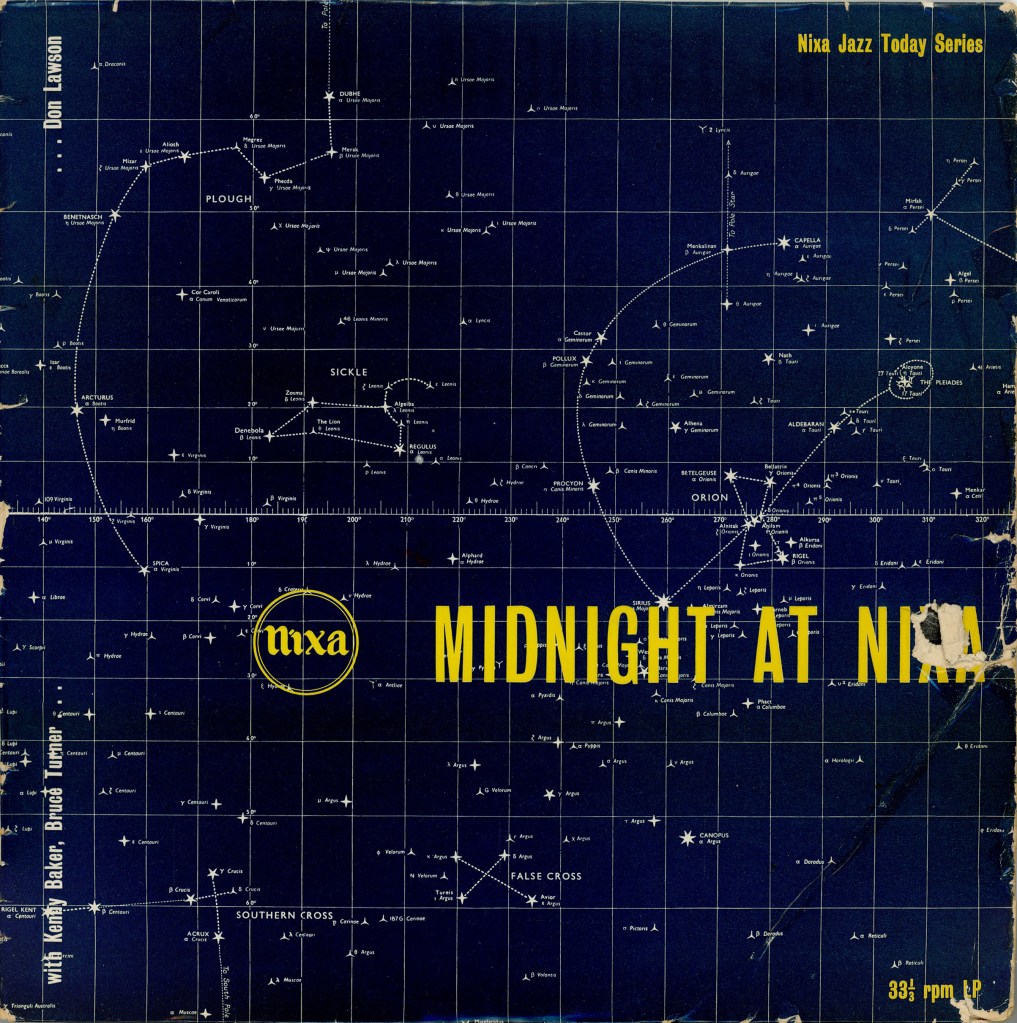
Cover illustration is reproduced from a Star Recognition chart by Francis Chichester, published by George Allen & Unwin Ltd., London.
Recording:
Joe Meek (balance)
Denis Preston (supervision)
 Nixa Jazz Today