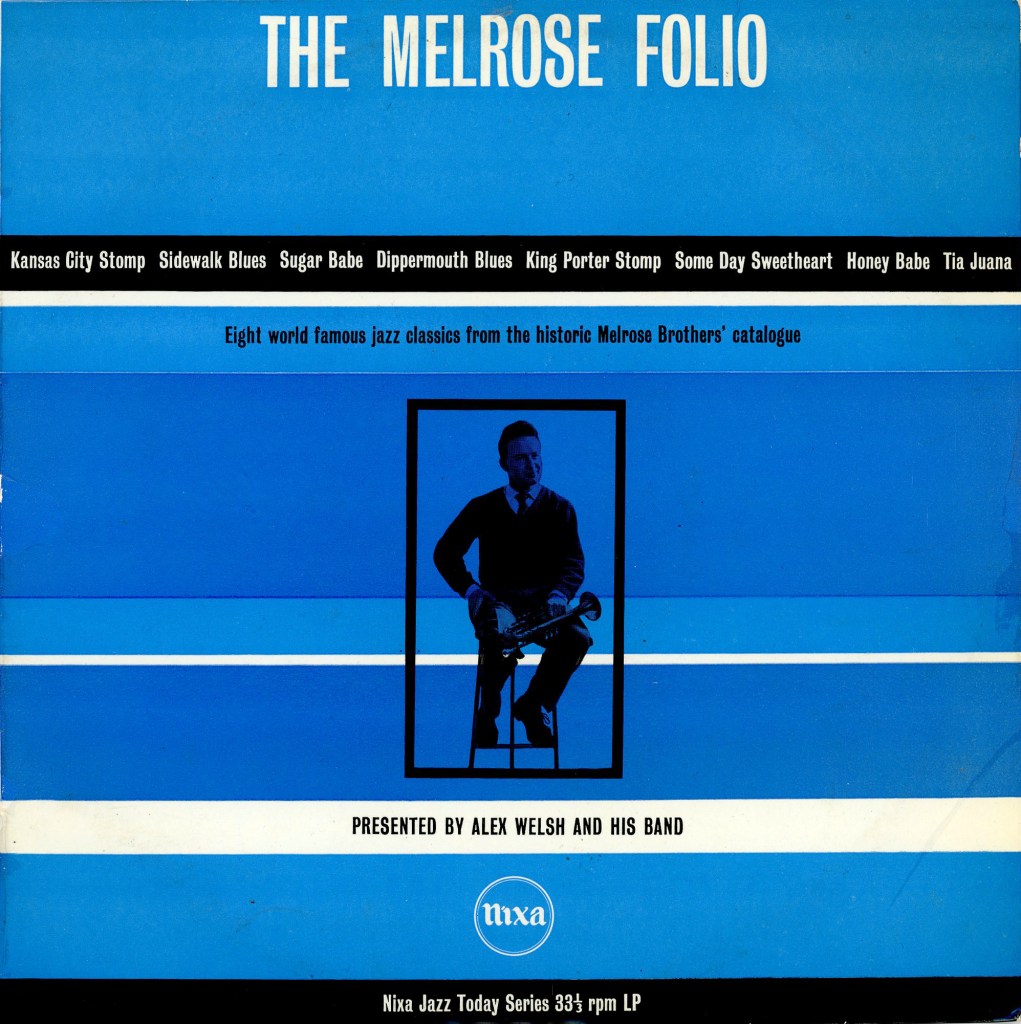
Pye Nixa NJT 516
Nixa Jazz Today Series
10” LP
Recorded Feb/March 1958
Tracks
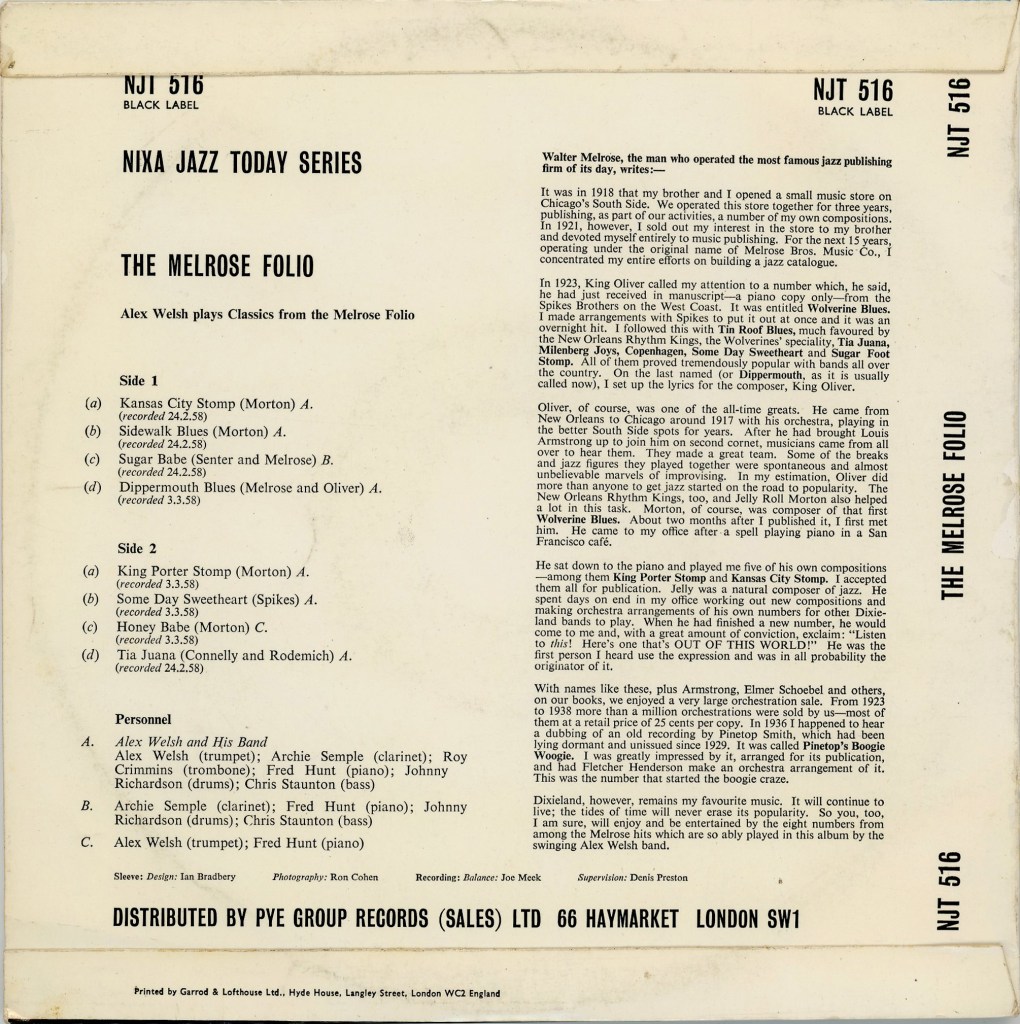
Side 1
(a) Kansas City Stomp (Morton) A.
(recorded 24.2.58)
(b) Sidewalk Blues (Morton) A.
(recorded 24.2.58)
(c) Sugar Babe (Senter and Melrose) B.
(recorded 24.2.58)
(d) Dippermouth Blues (Melrose and Oliver) A.
(recorded 3.3.58)
Side 2
(a) King Porter Stomp (Morton) A.
(recorded 3.3.58)
(b) Some Day Sweetheart (Spikes) 4.
(recorded 3.3.58)
(c) Honey Babe (Morton) C.
(recorded 3.3.58)
(d) Tia Juana (Connelly and Rodemich) A.
(recorded 24.2.58)
Sleeve Notes
Walter Melrose, the man who operated the most famous jazz publishing firm of its day, writes:-
It was in 1918 that my brother and I opened a small music store on Chicago’s South Side. We operated this store together for three years, publishing, as part of our activities, a number of my own compositions. In 1921, however, I sold out my interest in the store to my brother and devoted myself entirely to music publishing. For the next 15 years, operating under the original name of Melrose Bros. Music Co., I concentrated my entire efforts on building a jazz catalogue.
In 1923, King Oliver called my attention to a number which, he said, he had just received in manuscript – a piano copy only – from the Spikes Brothers on the West Coast. It was entitled Wolverine Blues. I made arrangements with Spikes to put it out at once and it was an overnight hit. I followed this with Tin Roof Blues, much favoured by the New Orleans Rhythm Kings, the Wolverines’ speciality, Tia Juana, Milenberg Joys, Copenhagen, Some Day Sweetheart and Sugar Foot Stomp. All of them proved tremendously popular with bands all over the country. On the last named (or Dippermouth, as it is usually called now), I set up the lyrics for the composer, King Oliver.
Oliver, of course, was one of the all-time greats. He came from New Orleans to Chicago around 1917 with his orchestra, playing in the better South Side spots for years. After he had brought Louis Armstrong up to join him on second cornet, musicians came from all over to hear them. They made a great team. Some of the breaks and jazz figures they played together were spontaneous and almost unbelievable marvels of improvising. In my estimation, Oliver did more than anyone to get jazz started on the road to popularity. The New Orleans Rhythm Kings, too, and Jelly Roll Morton also helped a lot in this task. Morton, of course, was composer of that first Wolverine Blues. About two months after I published it, I first met him. He came to my office after a spell playing piano in a San Francisco café.
He sat down to the piano and played me five of his own compositions – among them King Porter Stomp and Kansas City Stomp. I accepted them all for publication. Jelly was a natural composer of jazz. He spent days on end in my office working out new compositions and making orchestra arrangements of his own numbers for other Dixie land bands to play. When he had finished a new number, he would come to me and, with a great amount of conviction, exclaim: “Listen to this! Here’s one that’s OUT OF THIS WORLD!” He was the first person I heard use the expression and was in all probability the originator of it.
With names like these, plus Armstrong, Elmer Schoebel and others, on our books, we enjoyed a very large orchestration sale. From 1923 to 1938 more than a million orchestrations were sold by us – most of them at a retail price of 25 cents per copy. In 1936 I happened to hear a dubbing of an old recording by Pinetop Smith, which had been lying dormant and unissued since 1929. It was called Pinetop’s Boogie Woogie. I was greatly impressed by it, arranged for its publication, and had Fletcher Henderson make an orchestra arrangement of it. This was the number that started the boogie craze.
Dixieland, however, remains my favourite music. It will continue to live; the tides of time will never erase its popularity. So you, too, I am sure, will enjoy and be entertained by the eight numbers from among the Melrose hits which are so ably played in this album by the swinging Alex Welsh band.
Personnel
A. Alex Welsh and His Band
Alex Welsh (trumpet); Archie Semple (clarinet); Roy Crimmins (trombone); Fred Hunt (piano); Johnny Richardson (drums); Chris Staunton (bass)
B. Archie Semple (clarinet); Fred Hunt (piano); Johnny Richardson (drums); Chris Staunton (bass)
C. Alex Welsh (trumpet); Fred Hunt (piano)
Sleeve:
Design: Ian Bradbery
Photography: Ron Cohen
Recording:
Balance: Joe Meek
Supervision: Denis Preston
 Nixa Jazz Today