Polygon JTL3
Jazz Today
10” EP
Recorded March 1955
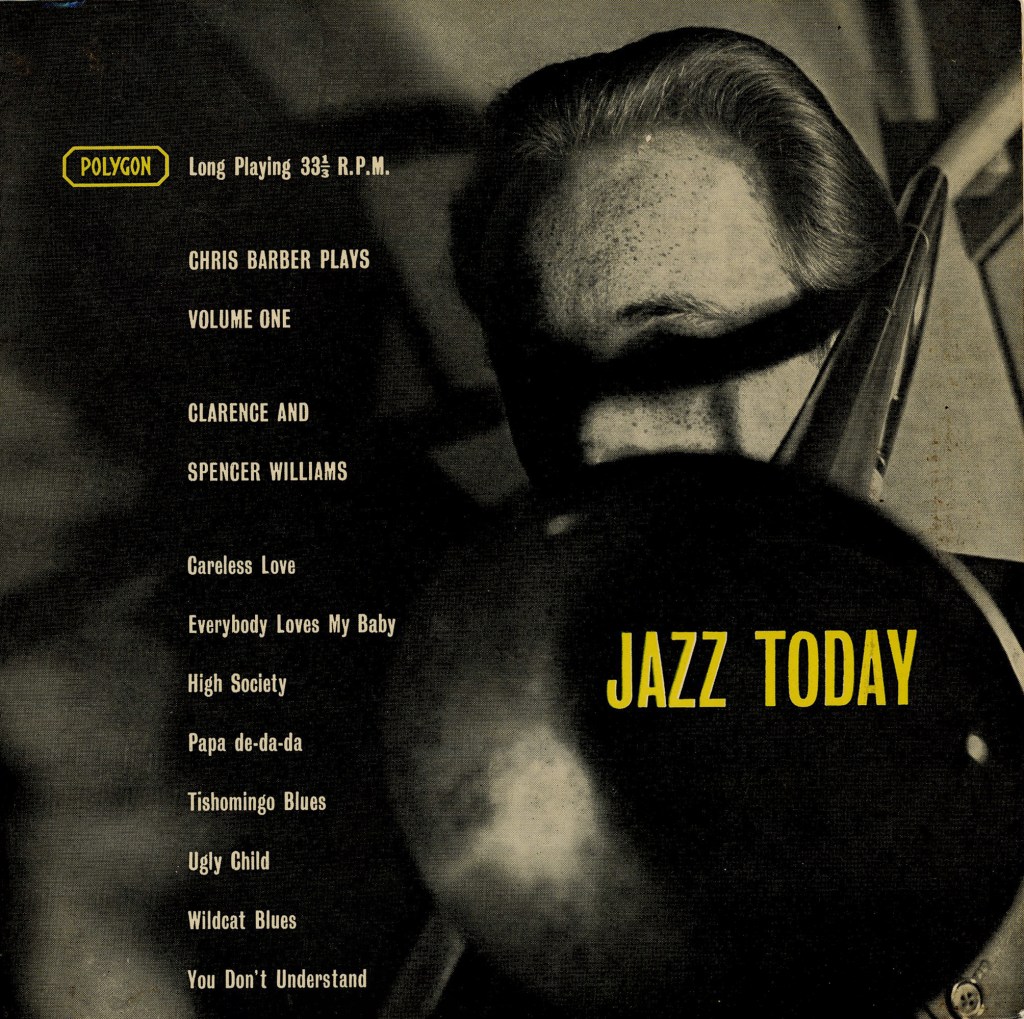
Tracks
Side 1
You Don’t Understand (Johnson, C. & S. Williams) (A)
(recorded 3/3/55)
Tishomingo Blues (S. Williams) (A)
(recorded 9/3/55)
Wild Cat Blues (C. Williams & Bechet) (C)
(recorded 9/3/55)
Ugly Child (C. Williams) (B)
(recorded 9/3/55) .
Side 2
Everybody Loves My Baby (Palmer & S. Williams) (A)
(recorded 8/3/55)
Careless Love (Trad. arr. S. Williams) (B)
(recorded 8/3/55)
Papa De-Da-Da (C. Williams and Todd) (A)
(recorded 8/3/55)
High Society (Porter Steele, arr. C. Williams) (A)
(recorded 18/3/55)
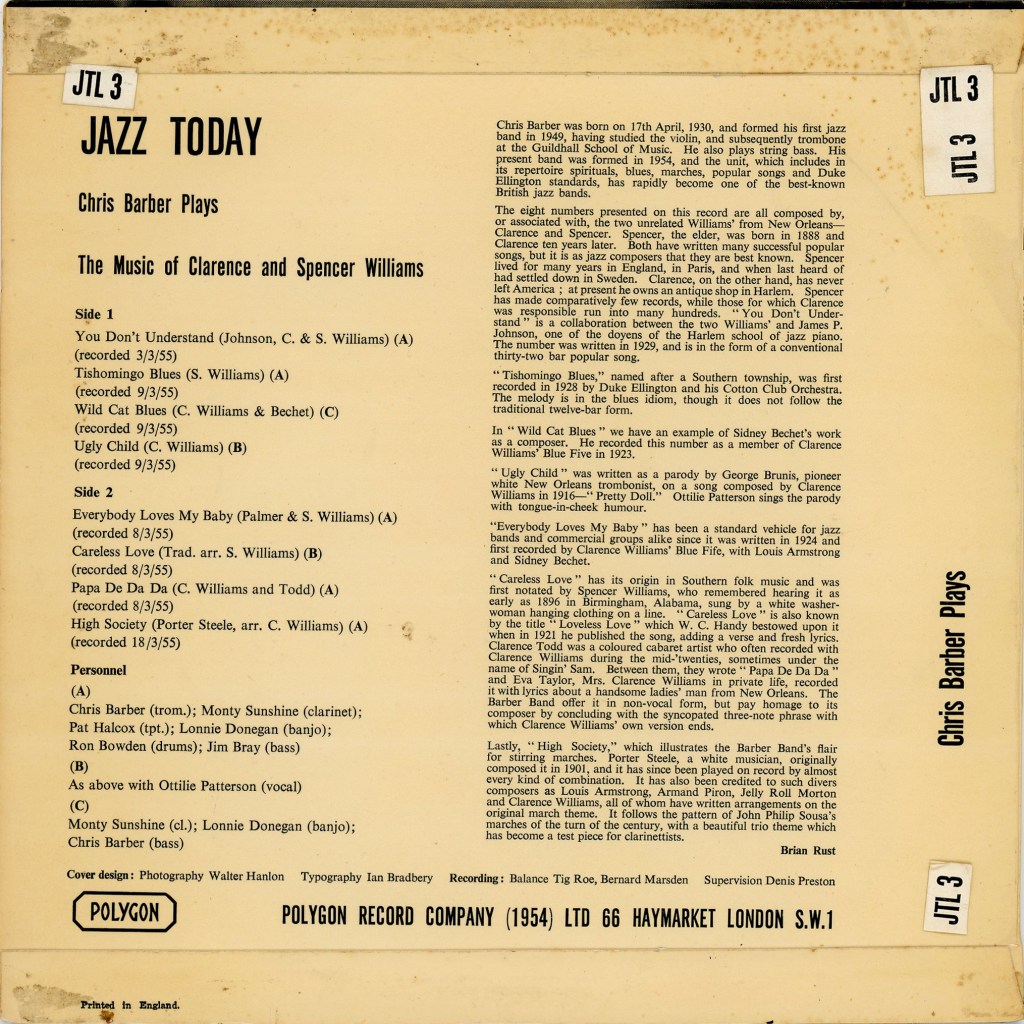
Sleeve notes
Chris Barber was born on 17th April, 1930, and formed his first jazz band in 1949, having studied the violin, and subsequently trombone at the Guildhall School of Music. He also plays string bass. His present band was formed in 1954, and the unit, which includes in its repertoire spirituals, blues, marches, popular songs and Duke Ellington standards, has rapidly become one of the best-known British jazz bands.
The eight numbers presented on this record are all composed by, or associated with, the two unrelated Williams’ from New Orleans – Clarence and Spencer. Spencer, the elder, was born in 1888 and Clarence ten years later. Both have written many successful popular songs, but it is as jazz composers that they are best known. Spencer lived for many years in England, in Paris, and when last heard of had settled down in Sweden. Clarence, on the other hand, has never left America; at present he owns an antique shop in Harlem. Spencer has made comparatively few records, while those for which Clarence was responsible run into many hundreds. “You Don’t Understand” is a collaboration between the two Williams’ and James P. Johnson, one of the doyens of the Harlem school of jazz piano. The number was written in 1929, and is in the form of a conventional thirty-two bar popular song.
“Tishomingo Blues”, named after a Southern township, was first recorded in 1928 by Duke Ellington and his Cotton Club Orchestra. The melody is in the blues idiom, though it does not follow the traditional twelve-bar form.
In “Wild Cat Blues” we have an example of Sidney Bechet’s work as a composer. He recorded this number as a member of Clarence Williams’ Blue Five in 1923.
“Ugly Child” was written as a parody by George Brunis, pioneer white New Orleans trombonist, on a song composed by Clarence Williams in 1916 – “Pretty Doll”. Ottilie Patterson sings the parody with tongue-in-cheek humour.
“Everybody Loves My Baby” has been a standard vehicle for jazz bands and commercial groups alike since it was written in 1924 and first recorded by Clarence Williams’ Blue Five, with Louis Armstrong and Sidney Bechet.
“Careless Love” has its origin in Southern folk music and was first notated by Spencer Williams, who remembered hearing it as early as 1896 in Birmingham, Alabama, sung by a white washerwoman hanging clothing on a line. “Careless Love” is also known by the title “Loveless Love” which W. C. Handy bestowed upon it when in 1921 he published the song, adding a verse and fresh lyrics. Clarence Todd was a coloured cabaret artist who often recorded with Clarence Williams during the mid-‘twenties, sometimes under the name of Singin’ Sam. Between them, they wrote “Papa De-Da-Da” and Eva Taylor, Mrs. Clarence Williams in private life, recorded it with lyrics about a handsome ladies’ man from New Orleans. The Barber Band offer it in non-vocal form, but pay homage to its composer by concluding with the syncopated three-note phrase with which Clarence Williams’ own version ends.
Lastly, “High Society”, which illustrates the Barber Band’s flair for stirring marches. Porter Steele, a white musician, originally composed it in 1901, and it has since been played on record by almost every kind of combination. It has also been credited to such divers composers as Louis Armstrong, Armand Piron, Jelly Roll Morton and Clarence Williams, all of whom have written arrangements on the original march theme. It follows the pattern of John Philip Sousa’s marches of the turn of the century, with a beautiful trio theme which has become a test piece for clarinetists.
Brian Rust
Personnel
(A)
Chris Barber (trom.); Monty Sunshine (clarinet); Pat Halcox (tpt.); Lonnie Donegan (banjo); Ron Bowden (drums); Jim Bray (bass)
(B)
As above with Ottilie Patterson (vocal)
(C)
Monty Sunshine (cl.); Lonnie Donegan (banjo); Chris Barber (bass)
Sleeve:
Designer: Ian Bradbery
Photography: Walter Hanlon
Recording:
Balance: Tig Roe, Bernard Marsden
Supervision: Denis Preston
 Nixa Jazz Today